

Email marketing still delivers one of the strongest returns of any digital channel, yet most small businesses treat it like a numbers game. Send more, reach more, win more. The reality is sharply different. Industry benchmarks show ROI ranging from $36 to $42 for every $1 spent, but only when campaigns are guided by real data. Volume without strategy is just noise. This guide walks you through exactly how data analytics transforms email marketing from a guessing game into a predictable growth engine, covering segmentation, personalization, key metrics, privacy compliance, and a practical action plan you can start using today.
Table of Contents
- Why data matters in email marketing
- The key roles data plays in successful campaigns
- Measuring what matters: benchmarks and metrics
- Common pitfalls and expert nuances in data-driven email marketing
- Privacy, ethics, and compliance: the responsible use of data
- Next steps: applying data insights for email campaign growth
- Harness powerful data tools with Loomail
- Frequently asked questions
Key Takeaways
| Point | Details |
|---|---|
| Data drives effectiveness | Segmentation, personalization, and automation powered by data lead to higher email performance. |
| Focus on true metrics | Click-through rates and revenue-per-recipient are more reliable than open rates in 2026. |
| Ethical data use is vital | Comply with privacy laws and use zero-party data to build trust and stay compliant. |
| Avoid common mistakes | Dynamic segments and measured automation improve results while over-complication hurts ROI. |
| Take immediate action | Start small with segmentation and personalization to see quick improvements in your campaigns. |
Why data matters in email marketing
Most email campaigns fail quietly. They land in inboxes, get ignored, and the sender assumes the list is just cold. But the real issue is almost always relevance, and relevance is a data problem. When you send the same message to every subscriber regardless of their behavior, location, or purchase history, you are essentially shouting into a crowd and hoping someone responds.
Data changes that equation entirely. Segmentation, personalization, and automation all depend on data to function, and together they dramatically improve how relevant your emails feel to each recipient. A subscriber who just bought a product does not need a welcome email. A lead who opened three emails but never clicked needs a different nudge than one who clicked but never converted. Data tells you who is who.
The contrast between gut-feeling and data-driven strategy shows up fast in results. Marketers who use behavioral data to guide their email campaign effectiveness consistently outperform those who rely on intuition alone. Better open rates, higher click-through rates, and stronger revenue per send are not accidents. They are the output of treating data as a strategic asset rather than a reporting afterthought.
"Data is not just a reporting tool. It is the foundation of every decision that makes email marketing work at scale."
- Improved targeting reduces unsubscribes
- Personalized content increases click-through rates
- Behavioral triggers improve send timing
- Analytics reveal what to fix before the next campaign
The key roles data plays in successful campaigns
With the "why" established, let's look at the tangible ways data transforms your email approach across four core functions.
Segmentation is the practice of dividing your list into groups based on shared characteristics. Those characteristics can be demographic (age, location, job title), behavioral (pages visited, emails clicked, products purchased), or psychographic (interests, values). The more specific your segments, the more relevant your messaging becomes.
Personalization goes beyond inserting a first name. It means customizing subject lines based on past behavior, adjusting content blocks based on purchase history, and sending at the time each subscriber is most likely to engage. Even small personalization touches, like referencing a product category someone browsed, can lift click rates noticeably.
Automation uses data triggers to send the right message at the right moment without manual effort. A subscriber who abandons a cart gets a follow-up. A customer who hits a one-year anniversary gets a loyalty offer. These triggered sends feel timely and personal because they are based on real actions, not a broadcast schedule.
Optimization closes the loop. A/B testing subject lines, send times, and content layouts gives you hard data on what works. Over time, each campaign teaches you something the next one can use.
| Feature | Static segmentation | Dynamic segmentation |
|---|---|---|
| Updates automatically | No | Yes |
| Based on real-time behavior | No | Yes |
| Requires manual refresh | Yes | No |
| Best for | Fixed lists, one-time sends | Ongoing nurture campaigns |
| Risk | Becomes outdated quickly | Requires clean, connected data |
Pro Tip: Automation is powerful, but do not let it run completely unsupervised. Review triggered sequences every quarter to make sure the messaging still reflects your brand voice and current offers.
Measuring what matters: benchmarks and metrics
Understanding what to measure is as important as knowing how to use data. Let's clarify the modern standards for campaign success.

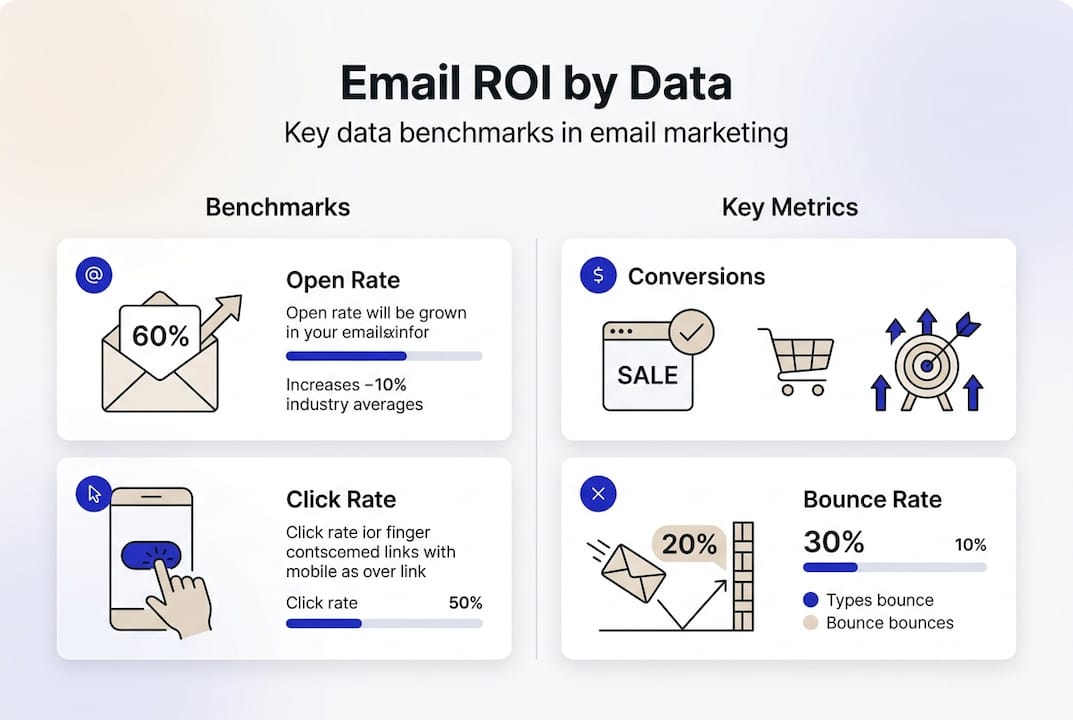
Current 2026 email benchmarks show average open rates between 35.9% and 42.35%, click-through rates between 2.0% and 2.62%, and click-to-open rates (CTOR) between 5.63% and 6.81%. Those open rate numbers look impressive, but there is an important caveat.
Apple's Mail Privacy Protection (MPP) and Gmail AI tracking disruptions have made open rates increasingly unreliable as a standalone metric. MPP pre-loads email content, registering an open even when the subscriber never actually read the message. This inflates open rate data significantly. Smart marketers are shifting focus toward CTR, CTOR, conversion rate, and revenue per recipient as more honest indicators of campaign health.
Here are the four KPIs small businesses should prioritize:
- Click-through rate (CTR): Measures how many recipients clicked a link. This reflects genuine interest and content relevance.
- Click-to-open rate (CTOR): Compares clicks to opens, showing how well your content converts readers who did open the email.
- Conversion rate: Tracks how many email-driven clicks resulted in a purchase, signup, or other goal action.
- Revenue per recipient: Divides total email-driven revenue by the number of recipients. This is the clearest measure of actual business impact.
| Metric | 2026 benchmark | What it tells you |
|---|---|---|
| Open rate | 35.9% to 42.35% | Deliverability and subject line appeal (MPP-inflated) |
| CTR | 2.0% to 2.62% | Content relevance and CTA strength |
| CTOR | 5.63% to 6.81% | Body content effectiveness |
| Deliverability | 98% | Inbox placement health |
Pro Tip: If your CTR is strong but conversions are low, the problem is likely your landing page, not your email. Treat email analytics and website analytics as connected, not separate.
Common pitfalls and expert nuances in data-driven email marketing
Once you know what to measure, it is crucial to avoid the common stumbling blocks that trip up even experienced marketers.
The biggest trap is over-segmentation. It sounds counterintuitive, but creating too many micro-segments adds complexity without adding proportional ROI. When you have 40 segments and only a few hundred subscribers each, managing personalized content for all of them becomes unsustainable. Start with five to eight meaningful segments and expand only when the data justifies it.
Static segments are another common mistake. A segment built on last year's purchase data does not reflect what subscribers care about today. Dynamic segments integrated with your CRM update automatically based on real-time behavior, keeping your targeting accurate without constant manual work. They consistently outperform static lists in engagement and revenue metrics.
Automation is genuinely powerful for ROI, but over-reliance on AI without human oversight creates its own risks. Automated sequences can go stale, send tone-deaf messages during sensitive periods, or continue promoting products that are out of stock. A human review cycle keeps automation aligned with reality.
"Measuring revenue per recipient, not just open rates, is what separates marketers who understand their data from those who are just watching numbers."
- Avoid building segments too small to test meaningfully
- Audit automated sequences at least once per quarter
- Connect your email platform to your CRM for unified subscriber data
- Replace static lists with dynamic segments wherever possible
Privacy, ethics, and compliance: the responsible use of data
Data's power comes with responsibility. Here is how you can drive results without crossing ethical or legal lines.
Three major regulations shape how email marketers can collect and use subscriber data in 2026. GDPR (Europe), CCPA (California), and CAN-SPAM (United States) each set rules around consent, data storage, and the right to unsubscribe. Violating them is not just a legal risk. It damages trust with the very audience you are trying to build.
Zero-party data, explicit consent, and data minimization are the three pillars of ethical email marketing. Zero-party data is information subscribers choose to share directly with you, like preferences selected during signup or answers to a survey. It is more accurate than inferred data and comes with built-in consent, making it both more ethical and more useful.
Here is how to build a compliant data practice:
- Use a clear opt-in process. Never add contacts without explicit permission. A double opt-in confirms intent and protects you legally.
- State what data you collect and why. Transparency at signup builds trust and reduces future unsubscribes.
- Practice data minimization. Collect only what you actually need to personalize and segment effectively. More data is not always better.
- Honor unsubscribe requests immediately. CAN-SPAM requires removal within 10 business days, but best practice is instant.
- Keep your list clean. Remove hard bounces and long-inactive subscribers regularly to protect deliverability.
Pro Tip: Never paste sensitive subscriber data, like health information or financial details, into AI writing or segmentation tools. Most AI platforms store input data, which creates compliance exposure under GDPR and CCPA.
Next steps: applying data insights for email campaign growth
Armed with context, cautions, and compliance guidelines, you can take targeted action starting today.
The most common mistake at this stage is trying to do everything at once. Marketers audit their list, build ten segments, set up twelve automations, and redesign their templates all in the same week. Then nothing gets done well. A phased approach works far better.
Segmentation, personalization, and automation each build on each other, so the sequence matters. Here is a practical six-step blueprint:
- Audit your list. Remove invalid addresses, hard bounces, and contacts who have not engaged in over 12 months. A clean list is the foundation of accurate data.
- Collect or confirm consent. Run a re-engagement campaign for older contacts and implement double opt-in for all new signups going forward.
- Build your first segments. Start with three to five groups based on the most meaningful behavioral or demographic differences in your list.
- Personalize your content. Customize subject lines and at least one content block per segment. You do not need a completely unique email for each group.
- Monitor your KPIs. Track CTR, CTOR, conversion rate, and revenue per recipient after each send. Give yourself at least three to five campaigns before drawing conclusions.
- Iterate based on results. Use A/B test data and KPI trends to refine segments, messaging, and timing with each campaign cycle.
Pro Tip: Pick one segment, run one personalized campaign, and measure the results before scaling. A small, well-executed test teaches you more than a large, rushed rollout.
Harness powerful data tools with Loomail
If you are ready to put these strategies into practice, the right platform makes all the difference. Loomail is built specifically for small businesses and marketing teams who want data-driven results without the complexity of enterprise tools.
The Loomail platform gives you real-time analytics for open rates, clicks, and bounces, along with built-in segmentation, drag-and-drop email building, and unlimited sends without hidden restrictions. You do not need to connect external SMTP services or manage technical infrastructure. Loomail handles deliverability, domain warmup, and bounce control internally, so your emails reach inboxes. Explore Loomail pricing and plans to find the right fit for your team size and send volume, and start turning your subscriber data into measurable revenue.
Frequently asked questions
Why is open rate less reliable due to privacy changes?
Apple MPP pre-loads emails, registering opens that never happened, while Gmail AI further disrupts tracking accuracy. Marketers should prioritize CTR and revenue per recipient as more reliable performance signals.
What is zero-party data and why is it important?
Zero-party data is information subscribers voluntarily share with you, such as preferences or survey answers. Because consent is explicit and the data comes directly from the subscriber, it is both more accurate and more compliant with privacy regulations.
How do I start using data in my email campaigns?
Begin by cleaning your list, then build simple segments based on subscriber behavior or demographics. Personalize subject lines and one content block per segment, then track CTR and conversion rate to measure impact.
Is automation better than regular email campaigns?
Automation consistently boosts ROI through timely, behavior-triggered sends, but it works best when paired with regular human review to keep messaging accurate, relevant, and on-brand.